The Huguenot Monument: A Symbol Built to Last 250 Years and Beyond
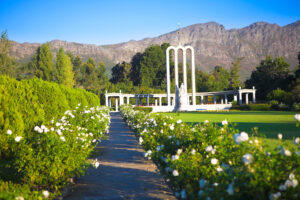
At the end of Huguenot Road, with the mountains directly behind it and the village spread before it, the Huguenot Monument stands as one of the most deliberately conceived pieces of public sculpture in South Africa. Every element of its design carries meaning. Nothing here is decorative for its own sake.
A Monument 250 Years in the Making
Construction began in 1938, in celebration of the 250th anniversary of the Huguenots' arrival at the Cape. The monument was inaugurated on 7 April 1948 .
Built from Paarl granite and Calvinia paving stones, the structure combines local materials with a design of considerable sophistication. Its character displays simplicity and elegance with historic French character.
Reading the Symbolism
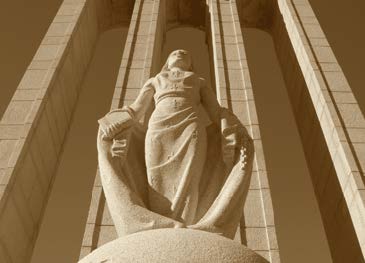
At the centre of the monument stands a female figure holding the Bible in her right hand and a broken chain in her left. She personifies the spirit of religious freedom, the freedom for which the Huguenots fled France, endured persecution, and ultimately made a new life at the southern tip of Africa. The fleur-de-lis on her robe represents noble spirit and character. She rises above a globe, discarding a cloak of suppression.
Around the base, the symbols of Huguenot life are rendered in stone: the Bible for religion, the harp for art and culture, the sheaf of corn and grapevine for agriculture and viticulture, the spinning wheel for industry. These were not incidental to the Huguenot story; they were its substance.
The three lofty arches represent the Holy Trinity. Above them, the Sun of Righteousness; above that, the Cross.
The Reflecting Pool
In front of the monument, the water pond reflects the colonnade behind it. In the words of the monument's own description, it expresses "the undisturbed tranquillity of mind and spiritual peace the Huguenots experienced after much conflict and strife." It is a place to pause.