
Groendal and the Franschhoek Social Accord: A Community Divided and Reunited
To understand Franschhoek fully, you need to understand what happened here in the middle of the twentieth century, and what was done in the years that followed to begin putting it right.
Until 1958, all races lived together in Franschhoek. That changed with the implementation of the Group Areas Act of 1951, one of apartheid's most destructive instruments of social engineering. Initial plans called for Black residents to be relocated to an area below the mountain pass at the southern end of the village. What ultimately emerged was the designation of the area now known as Groendal (also called Franschhoek North) as a Black area under the Act.
Le Rouxdorp: A Neighbourhood Repurposed by Force
The neighbourhood has older roots than apartheid. The residential area was originally proclaimed in 1900 on portions of the farms La Provence and La Terre de Luc, then owned by two members of the Le Roux family. It became known informally as Le Rouxdorp. When the Group Areas Act took effect, the community was arbitrarily reshuffled: white residents living in Le Rouxdorp were forced to move into Franschhoek proper, while Black residents of Franschhoek were compelled to move to Le Rouxdorp. Families were uprooted, communities were fractured, and a neighbourhood was remade by decree.
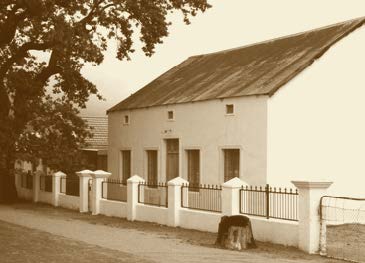
Despite this history, Groendal retains a number of noteworthy old buildings, particularly along Keerom and Stiebeuel Streets. Stiebeuel Street follows the route of the original wagon road into Franschhoek and is still flanked by rows of impressive old oak trees, lending it a quiet dignity that speaks to its age.
The Social Accord: A Village Chooses a Different Path
In February 1998, Franschhoek took a significant step toward reconciliation when the Franschhoek Social Accord was signed. It was a comprehensive agreement designed to address the injustices of the apartheid era in practical, lasting terms. A large tract of municipal commonage was sold to developers, with the proceeds used to cross-subsidise 1,000 low-cost houses in Franschhoek North/Groendal, settle outstanding land claims, and provide previously disadvantaged residents of the valley with meaningful access to agricultural and tourism-related business opportunities.
It was not a perfect solution to an imperfect history, but it was a genuine attempt by a community to reckon with its past and build something more equitable in its place.
Today
Several noteworthy old buildings remain in Groendal, particularly in Keerom and Stiebeuel Streets. Stiebeuel Street follows the route of the old wagon road into Franschhoek and is still lined with impressive old oak trees.