Franschhoek Town Hall: Civic Pride in Cape Dutch Revival Style
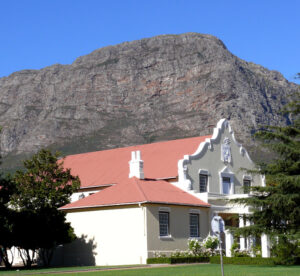
At the heart of the village, the Town Hall stands as a confident statement of civic identity. Built in 1935, it is one of the finest examples in Franschhoek of the Cape Dutch Revival style that was enormously popular in South African public architecture during the early twentieth century.
Reading the Gable
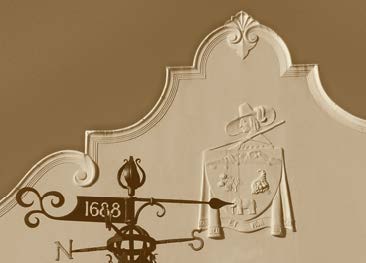
The gable of the Town Hall is worth pausing to examine. It depicts the town's heraldic crest in full: a Huguenot figure, the mountains that frame the valley, an elephant, fruit and proteas. Each element is deliberate, a visual summary of what Franschhoek understood itself to be. The Huguenot speaks to origin; the mountains to place; the elephant and fruit and proteas to the natural abundance of the Cape. Together they form a portrait of a community that knew its own story and was not shy about telling it.
The Fountain
In front of the Town Hall stands a fountain, a more recent addition to the space. It was a gift to the community from a local family, given in memory of a son who tragically disappeared while travelling in Europe. It is the kind of gift that transforms a civic space into something more personal: a place of public gathering that also holds private grief.
Today
The Town Hall remains a working civic building, a reminder that heritage is not always about the distant past, but about the ongoing life of a community that keeps showing up in the same place.