The Dutch Reformed Church: The Heart of Franschhoek Since 1847
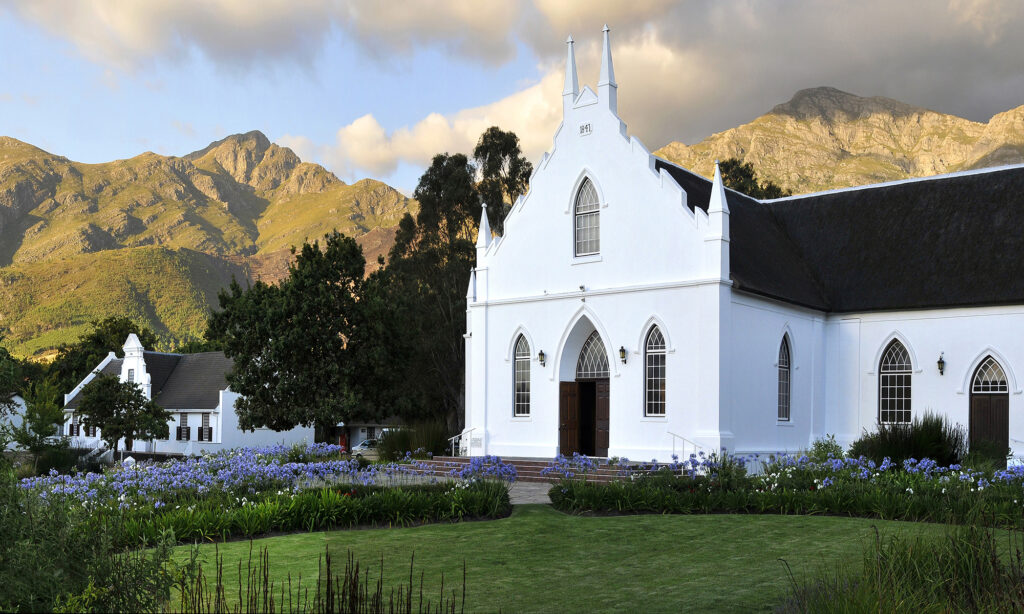
At the top of Huguenot Road, framed by mountains on every side, the Dutch Reformed Church is the oldest building in Franschhoek and one of the most photographed in the Winelands. But its story is about far more than architecture.
A Community Builds Its Church
In June 1845, a request was put to the government for two acres of outspan land. The intended purpose was practical and deeply communal: a church with enough surrounding space for wagon encampments during nagmaal, the Afrikaans tradition of communion, when farming families would travel in from across the valley and beyond to attend church, marry, and have their children baptised.
The land was granted, but no financial assistance was forthcoming. What followed was a remarkable act of community determination. Through donations and collections gathered across the country, enough funds were raised to build the church, and it was dedicated in April 1847 by the Reverend van der Lingen of Paarl.
The Architecture
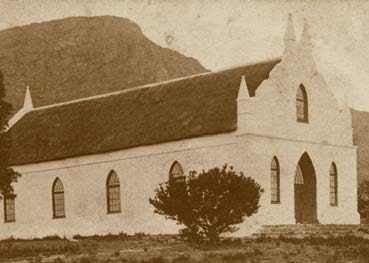
The original building was designed by Joseph James Turpin in the neo-gothic style. It is built on a stone foundation with kiln-brick walls, and features a beautiful gable, turrets, and peak-arched windows and doors. The original structure was rectangular. The wings were added in 1883, at which point the thatched roof was replaced with corrugated iron.
The first bell tower, built in 1852, collapsed and had to be replaced. The replacement took three years, not for structural reasons but for a very human one: the congregation could not agree on where the new tower should be positioned in order to be heard by the greatest number of people. The current tower, a product of that spirited debate, has stood ever since.
In 1968 the main building was renovated with new roof beams and rethatched, restoring something of its original character. In November 1972 the church, bell tower, and ring-wall were declared a National Monument, a fitting recognition of a building that has stood at the centre of community life for nearly two centuries.